
How to Choose a Salesforce Revenue Cloud Implementation Partner in the USA

Choosing a Salesforce Revenue Cloud implementation partner in the USA is a business decision that affects how your organization manages pricing, quoting, contracts, orders, subscriptions, and billing. The right partner should understand your revenue model, assess your existing systems, and develop an implementation plan that supports your commercial and operational objectives.
For B2B companies, the challenge often extends beyond Salesforce configuration. Sales, finance, pricing, and operations teams may follow different processes, maintain information across multiple systems, or depend on manual approvals to move deals forward. An implementation partner must understand these dependencies before recommending a solution.
We will explain how to evaluate Salesforce Revenue Cloud implementation partners, compare their consulting and implementation services, understand pricing models, assess technical expertise and implementation risks, and select a partner that aligns with your business goals, revenue processes, and long-term requirements.
What Is a Revenue Cloud?
Salesforce Revenue Cloud helps businesses manage the revenue lifecycle, from product configuration and pricing to quoting, contracts, orders, and billing. It extends beyond traditional CPQ capabilities by connecting these processes within a broader revenue management platform.
Salesforce CPQ was the legacy product for configuring products, calculating prices, and generating quotes. Salesforce has since introduced its newer Revenue Cloud offering, built on a more unified revenue management architecture.
What Is a Salesforce Implementation Partner?
A Salesforce implementation partner is a consulting company that helps businesses plan, configure, customize, integrate, and deploy Salesforce based on their operational requirements. The partner works with business and IT teams to align Salesforce capabilities with existing workflows, migrate relevant data, train users, and support the system after launch.
For B2B organizations, a Salesforce implementation partner can help connect sales, finance, customer operations, and other business functions while ensuring the solution supports the company's processes and growth plans.
When choosing a partner for Salesforce Revenue Cloud, look for experience in pricing management, Configure-Price-Quote (CPQ), quote approvals, contract workflows, ERP integrations, data migration, and ongoing support. The right partner should understand your revenue processes and define a practical implementation plan, project scope, budget, and measurable business objectives.
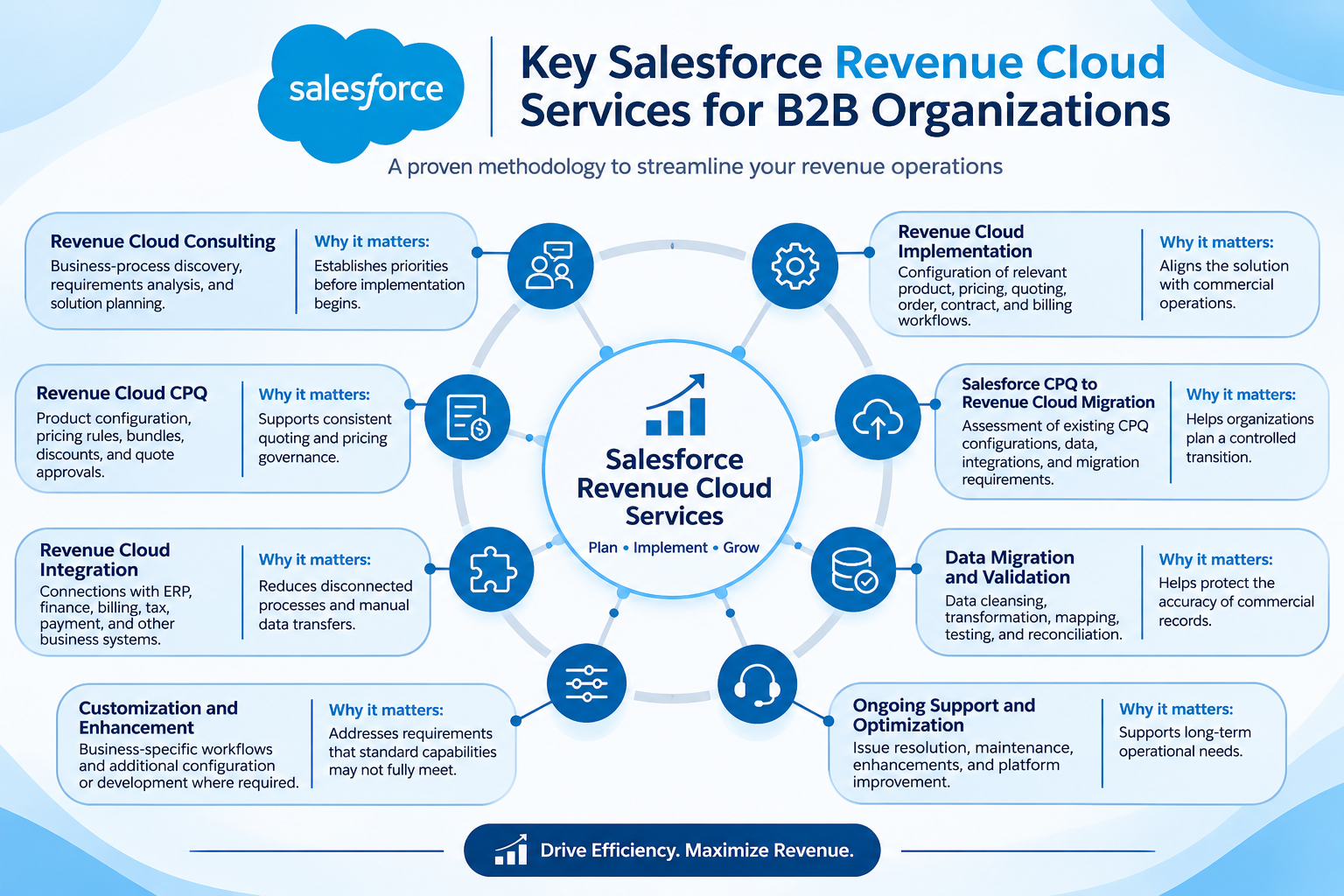
Which Services Does Your Business Need?
New implementation: Start with process discovery, requirements definition, architecture, and implementation planning.
Existing Salesforce CPQ environment: Assess the current configuration, pricing rules, integrations, and migration requirements before deciding on a transition strategy.
Disconnected finance or ERP systems: Prioritize integration architecture, data ownership, transaction validation, and error handling.
Complex pricing and product models: Review product configuration, pricing logic, discount governance, and quote approval workflows.
Post-launch improvement: Identify adoption issues, recurring errors, reporting gaps, and enhancements that support ongoing operations.
Before choosing a provider, ask which services are included in the proposed engagement and which require a separate agreement. Also establish who owns architecture decisions, integration development, testing, data validation, and post-launch support.
1. Evaluate the Partner's Salesforce Revenue Cloud Experience
A general Salesforce consulting background is useful, but it does not automatically demonstrate experience with complex revenue processes.
Look for a partner that can explain how it approaches product configuration, pricing, quoting, discount governance, contracts, orders, and relevant downstream integrations.
The depth of experience required depends on your business model. A company selling standardized products may need a different solution from a B2B technology provider managing subscriptions, negotiated enterprise agreements, or usage-based commercial models.
During partner discussions, ask:
Have you worked on implementations with similar product and pricing complexity?
How do you approach requirements that involve multiple business units or legal entities?
How do you validate pricing rules and discount approvals?
What integration and data migration challenges have you encountered?
Can you share a relevant case study or arrange a client reference?
Who will lead the solution architecture and business-process design?
Ask for concrete examples of implementation decisions and lessons learned. A partner should be able to explain its approach without relying solely on certifications or general claims about Salesforce expertise.
2. Assess Business-Process and Revenue Operations Expertise
A successful implementation begins with an understanding of how your business sells, prices, approves, and fulfills commercial agreements.
For B2B companies, the process may involve account executives, sales operations, pricing managers, finance teams, legal stakeholders, and order management teams. Each group may have different requirements and responsibilities.
Your implementation partner should document the current workflow, identify bottlenecks, and distinguish essential business rules from historical workarounds.
For example, a company may allow sales representatives to request special discounts through email. During discovery, the partner should establish which discounts require approval, who has approval authority, and how approved pricing should be reflected in the quote.
A structured assessment should cover:
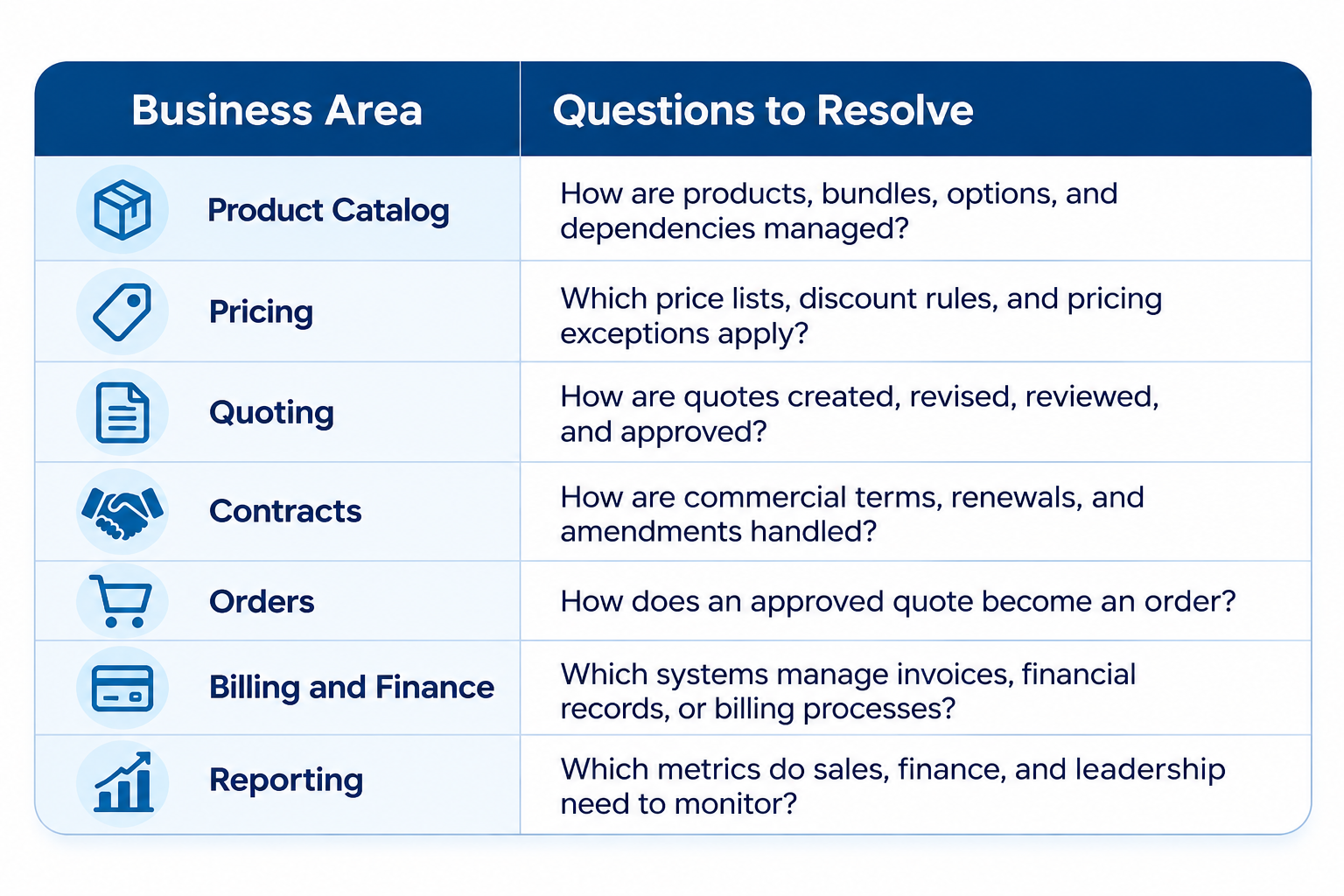
The output should be a documented set of business requirements, process flows, priorities, and acceptance criteria. These become the foundation for solution design and help prevent disagreements about project scope later.
3. Review Integration and Technical Architecture Capabilities
Many B2B organizations rely on an existing ERP, accounting platform, billing system, contract management application, or data warehouse. Revenue Cloud implementation must account for these systems rather than treating Salesforce as an isolated application.
Consider a software company that creates quotes in Salesforce but manages invoicing and financial records in an ERP. Its implementation partner needs to define which system owns product and customer information, how approved orders are transferred, and how integration failures are identified and resolved.
Evaluate the partner's ability to address:
System architecture: How Salesforce will interact with existing applications.
Data ownership: Which system is the authoritative source for each important record.
Integration patterns: Whether data should move in real time, on a schedule, or through another agreed mechanism.
Error handling: How failed transactions, incomplete updates, and duplicate records are managed.
Security: How access, credentials, and sensitive business information are protected.
Monitoring: How IT teams will identify integration failures and investigate issues.
Scalability: Whether the architecture can accommodate expected growth and additional requirements.
Request an architecture diagram before approving major integration work. It should identify connected systems, key data flows, dependencies, and ownership.
A technically sound implementation should also include integration testing and a clear process for monitoring and maintaining connections after deployment.
4. Understand the Data Migration Strategy
Existing product, customer, pricing, contract, and quote data may contain duplicates, outdated values, inconsistent formats, or incomplete relationships. Migrating these records without validation can introduce problems into the new environment.
A reliable implementation partner should assess data quality before finalizing the migration approach.
The process should include:
Inventorying source systems and relevant records.
Identifying duplicates, missing fields, and inconsistent data.
Mapping legacy records to the target data model.
Assigning business owners to approve data corrections.
Running trial migrations and testing representative scenarios.
Reconciling migrated data against agreed validation criteria.
Your organization should also decide which historical records need to remain operationally accessible and which can be retained in an archive or reporting environment.
Ask the partner how migration completeness, relationship integrity, and data accuracy will be measured. The migration plan should specify responsibilities, validation procedures, and how discrepancies will be resolved before go-live.
5. Evaluate Change Management and User Adoption
Revenue Cloud changes can affect how sales teams prepare quotes, how pricing managers approve discounts, and how finance teams receive commercial information.
If employees do not understand the new workflows, they may continue using spreadsheets, email approvals, or other workarounds outside the intended process.
Your implementation partner should include adoption planning in the project rather than treating training as a final deployment activity.
Look for a plan that covers:
Stakeholder interviews and workflow validation.
Role-based training for sales, pricing, finance, and operations.
User acceptance testing with representative business scenarios.
Clear communication about new responsibilities and approval procedures.
Documentation and training materials.
Post-launch feedback and issue resolution.
Define adoption measures before deployment. Depending on your objectives, these may include quote cycle time, approval turnaround, quote correction rates, workflow adoption, and the number of recurring support requests.
Use your own baseline to establish realistic targets. Avoid relying on generic ROI or productivity claims that have not been validated against your operating environment.
6. Compare Implementation Scope, Budget, and Delivery Governance
Implementation proposals can differ significantly even when vendors appear to be quoting for the same project.
One proposal may include process discovery, data cleansing, integrations, training, and post-launch support. Another may cover only configuration and deployment.
For this reason, compare the complete scope rather than selecting a partner based on the lowest initial estimate.
A transparent proposal should identify:
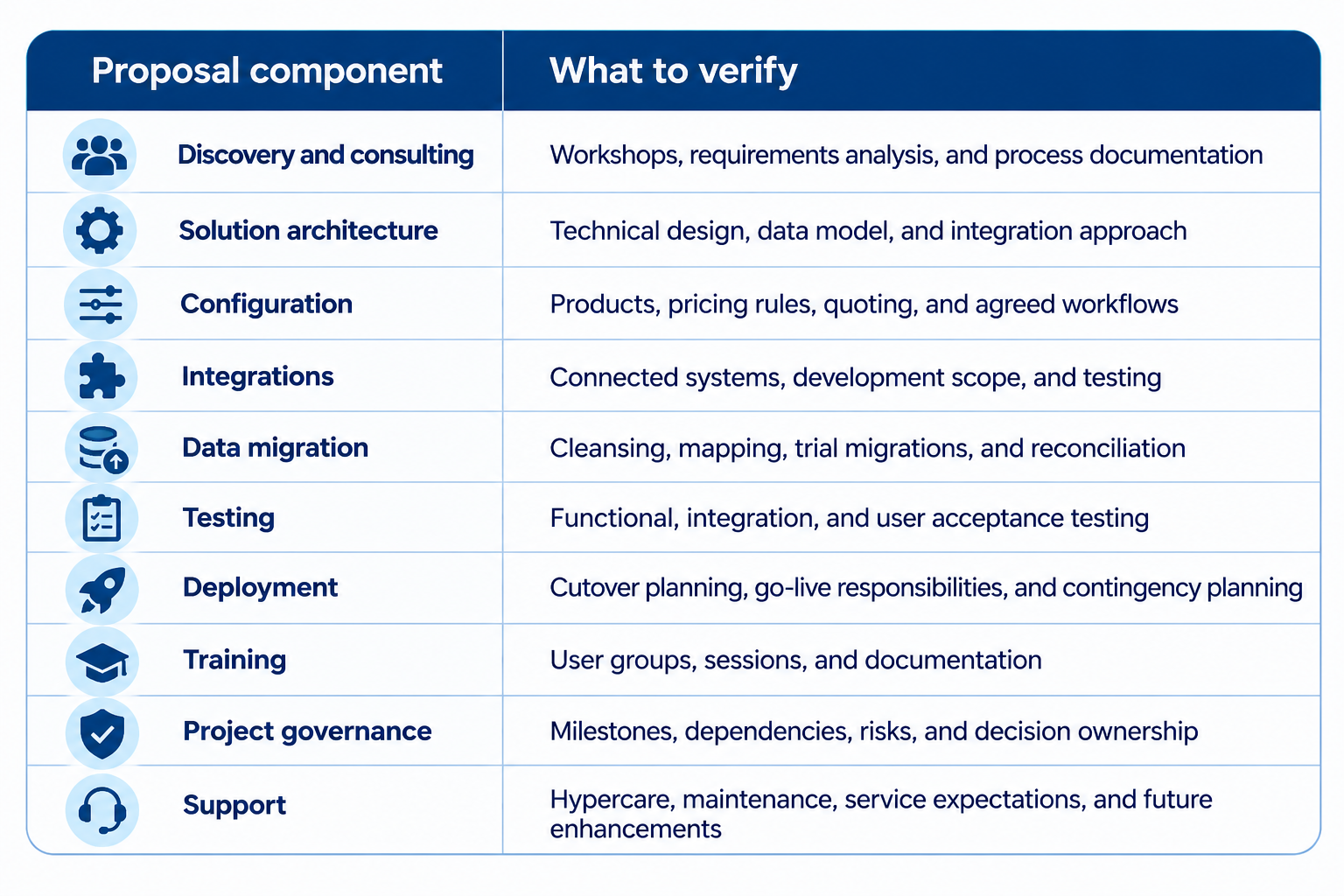
Also clarify the commercial model. A fixed-price contract may suit a well-defined scope, while a time-and-materials arrangement may be more flexible when requirements are still evolving. Both require clear reporting, change control, and accountability.
Before signing, confirm how additional requirements will be estimated and approved, who owns project decisions, and how delivery risks will be escalated.
7. Verify the Delivery Team's Technical and Functional Expertise
The company name on a proposal does not tell you who will actually deliver the work.
Ask to meet the people responsible for solution architecture, business analysis, configuration, integration development, data migration, testing, and deployment.
Evaluate their experience in:
Salesforce Revenue Cloud and relevant CPQ capabilities.
Enterprise architecture and integration design.
Product catalogs, pricing models, and quoting processes.
Data migration and quality validation.
Testing, deployment, and release management.
Business analysis and stakeholder coordination.
Training, support, and ongoing platform maintenance.
Certifications can help demonstrate knowledge, but practical experience with similar requirements is also important.
For enterprise projects, establish who is accountable for resolving conflicts between business needs, technical constraints, and third-party dependencies.
8. Evaluate Post-Implementation Support
Go-live is the beginning of operational use, not the end of the business's relationship with its implementation partner.
After deployment, users may identify workflow gaps, integrations may require adjustments, and the business may introduce new products, pricing structures, or approval requirements.
Before selecting a partner, ask how post-launch support will work.
Clarify whether the engagement includes:
Early production support and issue resolution.
Integration monitoring and troubleshooting.
Configuration changes and enhancements.
Release planning and regression testing.
User training and knowledge transfer.
Documentation and internal team enablement.
Ongoing optimization and advisory services.
A business with an established Salesforce team may need targeted specialist support. An organization with limited internal resources may prefer a broader managed services arrangement.
The important point is to define responsibilities, support expectations, and commercial terms before the implementation begins.
How Much Does Salesforce Revenue Cloud Implementation Cost in the USA?
The total cost depends on the Salesforce licenses your business requires, the complexity of your revenue processes, the implementation scope, and the consulting work needed to configure and integrate the platform.
For B2B decision-makers, it is important to separate software licensing from implementation services. Licensing is a recurring software expense, while consulting fees cover discovery, architecture, configuration, migration, integration, testing, deployment, and other agreed work.
Salesforce Revenue Cloud Licensing Prices
Salesforce's published pricing page currently lists these annual-billing prices for Revenue Cloud editions. Confirm the applicable product, feature entitlements, and commercial terms with Salesforce before making a purchasing decision.
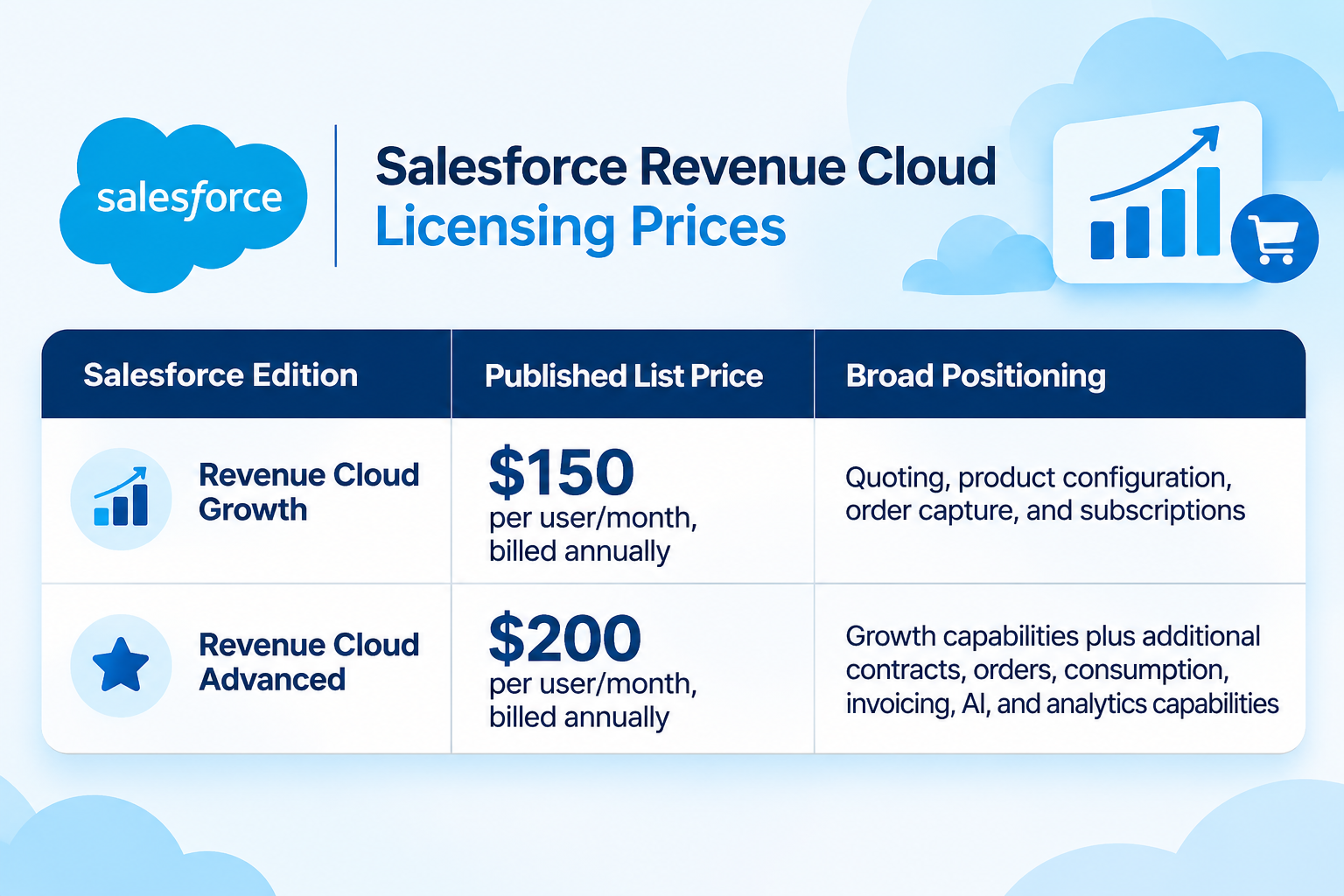
Pricing Disclaimer: Prices are published US list prices billed annually and are subject to change. Actual costs depend on the applicable contract, licenses, and separately licensed capabilities. Confirm current pricing and feature availability with Salesforce.
Source: Official Salesforce Revenue Cloud Pricing.
These are published software license prices, not implementation fees. The total subscription cost depends on the applicable agreement and number of licensed users. Additional products, services, or contractual requirements may also affect the total cost.
What Affects Salesforce Revenue Cloud Implementation Costs?
There is no single implementation fee that applies to every business. A focused quoting project and a multi-system enterprise deployment have different requirements.
The principal cost drivers include:
1. Business-process complexity
Multiple product catalogs, pricing models, discount rules, approval paths, and business units require more discovery, design, configuration, and testing.
2. Integration requirements
Connecting Salesforce with ERP, billing, finance, tax, payment, and other systems adds architecture, development, testing, and monitoring requirements.
3. Data migration
The condition of existing product, pricing, customer, contract, and quote data affects the work required for cleansing, transformation, mapping, and validation.
4. Customization and development
Requirements that cannot be addressed through the selected standard capabilities may require additional configuration or development. The partner should explain the rationale and long-term maintenance implications.
5. Testing and deployment
The number of workflows, integrations, user groups, and business scenarios influences the effort required for testing and production readiness.
6. Training and support
Organizations with multiple sales teams, finance departments, or regional operations may require broader training and post-launch support.
How to Request an Accurate Implementation Quote
Before asking Salesforce Revenue Cloud implementation partners for proposals, prepare a project brief that outlines your business objectives and existing environment.
Include the following information:
A clearly defined scope of work along with a list of deliverables.
The number and complexity of product and pricing models.
Your quoting, contract, order, and billing requirements.
The systems that need to integrate with Salesforce.
The volume and condition of the data that may need migration.
The teams involved in discovery, testing, and adoption.
Your target timeline, internal resources, and support requirements.
Ask vendors to separate consulting and implementation fees from software licenses, third-party costs, and ongoing support. Request clear deliverables, assumptions, exclusions, milestones, and change-request procedures.
This makes proposals easier to compare and helps leadership understand what is included in the estimated investment.
Need a Project-Specific Salesforce Revenue Cloud Estimate?
Every Revenue Cloud implementation has different requirements depending on pricing complexity, integrations, data migration, customization, and business workflows.
MV Clouds can help assess your existing Salesforce environment, understand your implementation requirements, and define the scope of consulting and implementation services needed for your project.
Share your project requirements with the MV Clouds team to discuss the potential implementation scope and request an estimate.
Salesforce Revenue Cloud Implementation Case Study: Managing Complex Quote-to-Cash Processes
Consider a B2B software company that sells subscriptions to enterprise customers across several regions. Its sales team prepares quotes in Salesforce, finance maintains billing records in another application, and pricing exceptions require approval from multiple stakeholders.
As the company expands, manual handoffs make it difficult to maintain consistent commercial information across systems.
An implementation project for this business might involve:
Documenting product, pricing, quoting, and approval processes.
Reviewing product catalogs and existing customer and pricing data.
Designing the Salesforce architecture and required integrations.
Configuring agreed quoting and commercial workflows.
Testing quote approvals and downstream order or billing handoffs.
Training sales, finance, and operations teams.
Monitoring adoption and resolving issues after deployment.
The implementation plan would depend on the selected Salesforce capabilities, existing systems, and business requirements. This example illustrates a possible project approach, not a guarantee of specific results.
Explore how a global enterprise approached quote-to-cash challenges involving quoting, pricing, contract lifecycle management, and billing through the MV Clouds Salesforce Revenue Cloud implementation case study.
How MV Clouds Supports Salesforce Revenue Cloud Implementation
Choosing an implementation partner should begin with a clear understanding of your business requirements, existing systems, and operational priorities.
MV Clouds provides Salesforce Revenue Cloud services covering consulting, implementation, CPQ, CPQ migration, integration, and data migration and validation. The scope for each engagement should be based on the organization's current environment and the outcomes it needs to support.
For B2B organizations, an initial discussion should establish:
Which revenue processes need improvement.
How product catalogs, pricing rules, quotes, contracts, and orders are managed.
Which ERP, finance, billing, or other systems need to connect with Salesforce.
What data needs to be migrated, cleansed, or validated.
Which requirements can be addressed through standard capabilities.
How testing, training, deployment, and post-launch support will be managed.
These discussions help establish the scope of work and identify the dependencies that need to be addressed before implementation begins.
Planning Your Salesforce Revenue Cloud Implementation?
Choosing the right implementation partner starts with understanding your revenue processes, technical requirements, and long-term business objectives.
Whether you are implementing Revenue Cloud for the first time, evaluating a Salesforce CPQ migration, or improving existing quote-to-cash workflows, MV Clouds can help you discuss the appropriate consulting and implementation approach.
Contact MV Clouds to discuss your Salesforce Revenue Cloud requirements and plan your next steps.
Frequently Asked Questions
1. How do I choose a Salesforce Revenue Cloud implementation partner in the USA?
Evaluate the partner's relevant project experience, business-process expertise, integration capabilities, migration strategy, delivery governance, and post-launch support. Request evidence of comparable work and compare proposals against the same scope and acceptance criteria.
2. How much does Salesforce Revenue Cloud implementation cost in the USA?
The cost depends on licensing, project scope, pricing complexity, integrations, data migration, customization, training, and ongoing support. Separate software subscription costs from consulting fees, and request a detailed proposal based on your business requirements.
3. What is included in Salesforce Revenue Cloud implementation services?
Depending on the agreed scope, services may include business-process discovery, solution architecture, product and pricing configuration, quoting, integrations, data migration, testing, deployment, and training. Confirm which capabilities and deliverables are included in each partner's proposal.
4. What is the difference between Revenue Cloud consulting and implementation?
Consulting focuses on understanding business requirements, assessing the existing environment, defining priorities, and developing a solution roadmap. Implementation covers the agreed design, configuration, integrations, migration, testing, and deployment activities. Some engagements include both.
5. Can Salesforce Revenue Cloud integrate with an ERP or billing system?
Yes, Salesforce Revenue Cloud can be integrated with ERP, finance, billing, and other business systems when the required integration approach and capabilities are available. The design should define data ownership, synchronization, security, error handling, and monitoring.
6. Should businesses migrate from Salesforce CPQ to Revenue Cloud?
The decision depends on current CPQ capabilities, business requirements, the existing technical environment, and the organization's roadmap. Assess current configurations, integrations, data, required capabilities, migration complexity, and the business case before committing to a transition.
7. How long does Salesforce Revenue Cloud implementation take?
The timeline depends on requirements, process complexity, data readiness, integration dependencies, testing, and stakeholder availability. Ask the partner for a phased delivery plan after discovery, with defined milestones, dependencies, and acceptance criteria.
8. How can B2B companies reduce Revenue Cloud implementation risks?
Document requirements, validate data quality, assess integrations early, involve business stakeholders, and establish clear project governance. Structured testing, realistic scope, user training, and a defined support plan help teams identify and manage risks before they affect production operations.
9. What should be included in a Salesforce Revenue Cloud implementation proposal?
A proposal should define scope, deliverables, architecture, integrations, migration, testing, deployment, training, milestones, assumptions, exclusions, pricing, and post-launch support. It should also explain how risks, dependencies, and changes to scope will be managed.
10. How do I request a Salesforce Revenue Cloud implementation estimate from MV Clouds?
Start by outlining your current Salesforce environment, business processes, integration requirements, migration needs, and project objectives. Contact MV Clouds to discuss the requirements and determine the appropriate scope for an implementation estimate.
