
How Salesforce Helps Telecommunications Companies Reduce Customer Churn and Improve Customer Retention

For telecommunication companies, winning the first customer is only part of the growth equation. Keeping that customer for another year, expanding their services, and preventing them from switching to a competitor can have an even greater impact on long-term revenue.
The exact market estimates differ because research firms use different definitions and methodologies. The more important takeaway for telecom executives is the direction of the market. More services create more customer data, more interactions, and more opportunities for churn.
The challenge is that telecom customers interact with providers across multiple channels such as websites, mobile apps, stores, call centers, email, chat, and social media. If customer information is scattered across these systems, service teams struggle to understand the complete customer relationship.
A telecom CRM can bring these customer interactions together, but the real value comes from connecting that information to sales, service, marketing, automation, and analytics. Salesforce helps telecommunications companies create a more connected view of customers and use that information to identify retention risks, personalize engagement, and coordinate action across teams.
Why Customer Retention Is a Major Challenge for Telecom Companies
Currently, telecom customers have a wide range of options. Consumers can easily compare pricing, network coverage, devices, streaming bundles, and broadband packages by clicking just a few buttons.
The price is important, but it is not the only factor that drives customers away. Service quality, billing problems, complicated plans, poor support, unresolved complaints, and a lack of personalized communication can all contribute to churn.
Recent J.D. Power research highlights the challenges. Its 2025 wireless study found that customer satisfaction was affected by the complexity of plans, products, payment options, and promotions.
This means that telecom companies need more than customer names and phone numbers. They need a system that helps teams understand:
What services does the customer currently use?
How long have they been a customer?
How frequently do they contact support?
Are there unresolved service issues?
What products or plans have they shown interest in?
Has their usage changed?
Are they approaching contract or promotion expiry?
Is there a pattern that suggests they may leave?
This is where CRM telecommunications strategies become valuable.
The U.S. Telecom Market Is Becoming More Complex
The U.S. telecom industry is evolving beyond traditional voice and connectivity services.
Market reports identify several important areas of growth and investment, including 5G, fiber, FWA, IoT/M2M connectivity, enterprise services, and eSIM.
Persistence Market Research estimates the U.S. telecom services market at approximately $218.9 billion in 2026, with the market projected to reach approximately $244.7 billion by 2033. Its analysis identifies 5G deployment, fiber investment, and machine-to-machine IoT connectivity among the market's important growth drivers.
Mordor Intelligence also highlights 5G standalone networks, FWA, IoT, enterprise connectivity, and eSIM adoption as important developments in the U.S. telecom market.
The exact market estimates differ because research firms use different definitions and methodologies. The more important takeaway for telecom executives is the direction of the market:
More services create more customer data, more interactions, and more opportunities for churn.
A CRM strategy therefore needs to evolve alongside the telecom business.
Why Salesforce Is Relevant to Telecom Customer Retention
Salesforce is more than a traditional customer database. For telecommunications companies, its value comes from connecting customer information with sales, service, engagement, automation, analytics, and industry-specific processes.
Salesforce Communications Cloud is purpose-built for communications service providers and includes industry-specific capabilities such as a communications data model, product catalog, CPQ, order capture, order management, and integrations.
This gives telecom companies a foundation for connecting customer-facing processes with the operational systems behind them.
The objective is not simply to put more information into Salesforce. The objective is to make customer information useful at the moment a business decision needs to be made.
For example, before an account manager contacts a high-value business customer about an additional service, the team should be able to understand the customer's current products, open service cases, previous interactions, contract status, and engagement history.
That context can change the conversation from a generic sales pitch to a more relevant customer discussion.
How Salesforce Supports Telecom Customer Retention
One of the biggest advantages of Salesforce for telecom companies is the ability to connect customer, account, service, product, and engagement information in one environment.
1. Build a 360-Degree View of Customer Data
One of the biggest advantages of CRM customer retention management is centralized customer information.
Without CRM, customer information may sit across billing platforms, help-desk applications, spreadsheets, marketing tools, and network systems. Teams may see only part of the customer's history.
A CRM can connect these data points and provide a more complete customer profile.
Example
Imagine a broadband customer has contacted support three times in two months regarding intermittent connectivity issues.
The marketing team may not know about those complaints and could send the customer a promotional email encouraging them to upgrade. That message could easily frustrate the customer.
With integrated CRM data, the marketing team can see that the customer has unresolved service problems. Instead of sending an upsell campaign, the company can prioritize service recovery.
This simple change can make retention efforts much more relevant.
2. Personalize Customer Communication
Telecom customers do not all have the same needs.
A new prepaid customer, a long-term postpaid customer, a family account, and an enterprise customer should not receive identical messages.
A CRM helps telecom companies segment customers based on factors such as:
Customer tenure
Service type
Usage patterns
Location
Customer value
Purchase history
Support history
Engagement level
Contract status
Product preferences
Marketing teams can then create more relevant campaigns.
For example:
Instead of:
Upgrade your plan today!
A more targeted message could be:
Your current data usage has increased over the past three months. Here are two plans that provide additional data without changing your existing services.
The second message is based on customer behavior rather than a generic promotion.
That distinction matters when the goal is long-term retention rather than simply generating another sale.
3. Identify Customers at Risk of Churning
One of the most valuable CRM use cases is identifying customers who may be preparing to leave.
A CRM does not magically know that a customer will churn. However, it can bring together signals that help teams identify potential risk.
Possible churn indicators include:
Multiple support complaints
Repeated billing disputes
Declining product usage
Reduced engagement
Missed payments
Frequent plan changes
Contract expiration
Negative customer feedback
Competitor-related inquiries
Long periods without engagement
These signals can be combined into a customer-risk score.
Example
Consider a customer who:
Has been with the provider for four years.
Recently contacted support three times.
Experienced a billing dispute.
Has a promotion ending next month.
Has reduced engagement with the company's digital channels.
Individually, each signal may not indicate churn. Together, they create a strong reason for the retention team to investigate.
The company could proactively contact the customer, resolve the billing issue, explain available plans, and offer an appropriate retention option.
This is much more effective than waiting until the customer requests a cancellation.
4. Improve Customer Service and Issue Resolution
Customer service has a direct impact on retention.
A telecom customer experiencing a network outage or billing issue does not want to repeat the same information to multiple representatives.
A CRM gives service teams access to the customer's previous interactions and open cases.
This can help representatives understand:
What happened previously
Which department handled the issue
What solution was offered
Whether the issue was resolved
How many times the customer contacted the company
Whether the problem has escalated
This context allows support teams to provide faster and more consistent responses.
Research cited by CSGI found that 46% of surveyed telecom customers had canceled a phone, internet, TV, or cable contract within the previous year because of poor customer service, while 21% reported churning after a single negative experience.
The lesson for telecom companies is straightforward: retention cannot be separated from customer service.
5. Automate Proactive Customer Engagement
Retention does not always require a phone call from an account manager.
Many retention activities can be automated through CRM workflows.
For example, a telecom CRM can trigger an automated workflow when:
A contract is approaching renewal
A promotion is about to expire
A customer reaches a usage threshold
A support case remains unresolved
A high-value customer submits a complaint
A customer becomes inactive
A customer becomes eligible for an upgrade
Salesforce automation can then assign a task, notify an account manager, trigger a customer communication, or initiate another retention workflow.
This allows telecom companies to move from reactive support to proactive customer engagement.
6. Build Better Retention Offers
Discounting every customer is not an effective retention strategy.
Some customers may leave because of price. Others may leave because of service quality, limited features, poor support, or an unsuitable plan.
CRM data helps companies understand the reason behind the risk.
For example:
| Customer Situation | Potential Retention Action |
|---|---|
| High usage | Recommend a better-fit data plan |
| Frequent service complaints | Prioritize service recovery |
| Promotion ending | Offer relevant renewal options |
| Low engagement | Launch targeted re-engagement |
| High-value customer | Assign priority support |
| Billing concerns | Resolve account issue before upselling |
The goal is to offer the right solution to the right customer, rather than giving everyone the same discount.
7. Connect Sales, Marketing, and Customer Service
Telecom retention is not the responsibility of one department.
Sales may understand customer purchases. Marketing may understand campaign engagement. Customer service may understand complaints. Account management may understand customer value.
When these teams operate independently, important information gets lost.
A telecom CRM creates a shared customer record that allows teams to work from the same information.
For example, if a customer has an unresolved service complaint, sales representatives should know that before approaching them with an upsell opportunity.
Likewise, once a service issue is resolved, marketing can re-engage the customer with a relevant offer.
This coordination creates a more consistent customer journey.
8. Use CRM Analytics to Understand Churn Patterns
CRM is not only about storing customer records. It can also help management understand why customers leave.
Telecom leaders can analyze metrics such as:
Monthly churn rate
Churn by customer segment
Churn by plan
Churn by geography
Support cases before churn
Average response time
Resolution time
Customer lifetime value
Retention campaign performance
Upgrade and renewal rates
For example, suppose analytics shows that customers who open three or more support tickets within 60 days have significantly higher churn.
That insight can lead to a new retention workflow.
Instead of waiting for these customers to cancel, the company could automatically flag them for proactive outreach.
9. Use AI to Identify Customer Risk Signals
Modern telecom CRM platforms can work alongside AI and analytics tools to identify customer risk patterns. Salesforce can help bring relevant customer and account data into workflows where AI can support prioritization, recommendations, and service processes.
AI models can analyze large volumes of customer data and identify combinations of behaviors that may be difficult to spot manually.
For example:
Customer A
Low support activity
Stable usage
High engagement
Long tenure
Customer B
Multiple complaints
Reduced usage
Recent billing dispute
Promotion ending soon
Customer B may require immediate attention even though they have not explicitly said they want to cancel.
AI does not replace the retention team. It helps the team prioritize where human intervention is most valuable.
Large telecom operators are already exploring this approach. Verizon, for example, has used AI to predict call reasons and route customers to appropriate agents, with the stated goal of improving customer experience and reducing churn.
10. Increase Customer Lifetime Value
Retention has a financial benefit beyond reducing churn.
A customer who stays longer has more opportunities to purchase additional services, upgrade plans, add lines, or adopt new products.
For telecom companies, this could include:
Mobile plans
Broadband
Devices
Security services
Streaming bundles
Business connectivity
IoT services
Cloud or managed services
CRM helps identify appropriate cross-sell and upsell opportunities based on customer needs.
For example, an existing broadband customer with consistently high usage may be a better candidate for a higher-tier plan than a customer with low usage.
The result is a more relevant sales process and potentially higher customer lifetime value.
Salesforce Communications Cloud for Telecom
For telecommunications companies, Salesforce Communications Cloud is particularly relevant because it is designed around communications-industry processes rather than treating telecom as a generic CRM use case.
Salesforce describes Communications Cloud as an industry-specific platform that includes a communications data model and capabilities such as Enterprise Product Catalog, Configure Price Quote, Order Capture, Order Management, Contract Lifecycle Management, and Integrations.
These capabilities are particularly relevant to telecom companies because their commercial processes can involve complex products, pricing, locations, contracts, and orders.
Key areas include:
Enterprise Product Catalog: Helps telecom organizations manage products, services, offers, and reusable product components.
Configure, Price, Quote (CPQ): Supports complex product configuration, pricing, quoting, and order processes for business and consumer services.
Order Capture and Order Management: Helps connect the sales process with order fulfillment and improve visibility into order progress.
Contract Lifecycle Management: Supports contract-related processes across the customer relationship.
Communications Data Model: Provides an industry-specific data foundation designed around communications business requirements.
Third-party Integration: Salesforce can connect with external BSS, OSS, billing, product catalog, and other enterprise systems through APIs and integration technologies. Salesforce specifically highlights TM Forum-related APIs and integration capabilities for communications use cases.
For telecom organizations, this is important because Salesforce does not necessarily need to replace every existing operational system. Instead, it can become part of a connected technology architecture.
Salesforce for B2B vs. B2C Telecommunications
While Salesforce can support both B2B and B2C telecommunications, the focus of this article is primarily on B2B telecom providers, where customer retention involves complex accounts, multiple stakeholders, contracts, locations, and service relationships.
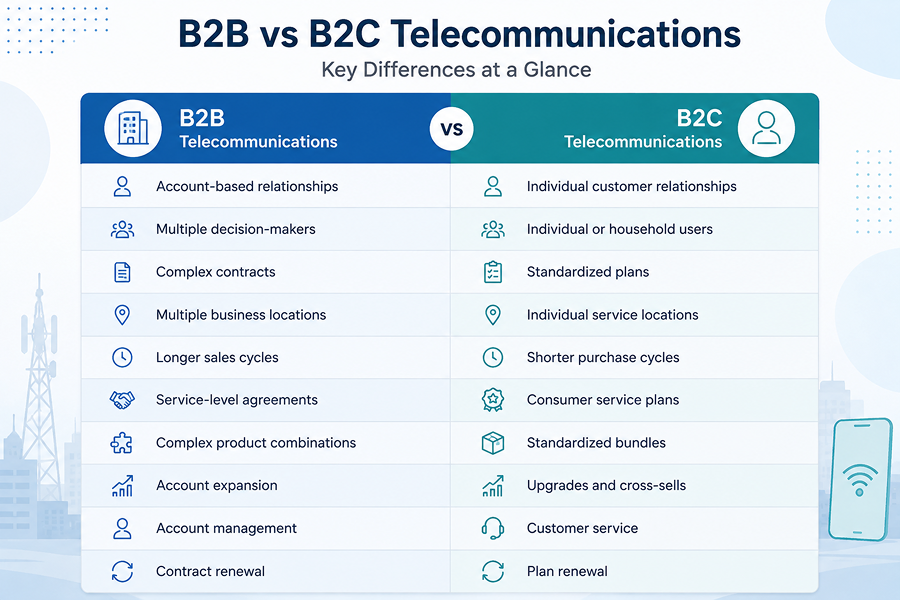
For B2B telecom providers, Salesforce should therefore be configured around the account relationship, not just the individual customer.
A B2B account may require visibility into parent-child account structures, locations, contacts, contracts, products, opportunities, orders, service cases, and renewal activities.
That makes account-level visibility and process integration particularly important.
How B2B Telecom Companies Can Get More Value From Salesforce
Implementing Salesforce alone does not improve retention. The system needs to support clearly defined retention processes.
Start With the Customer Journey
Map the important stages:
Acquisition → Onboarding → Usage → Support → Renewal → Expansion → Retention
Identify where customers experience friction at each stage.
Define the Right Churn Signals
Do not track every possible data point simply because the CRM can store it. Start with signals that have a clear relationship with churn.
Connect Critical Systems
Where appropriate, integrate CRM with billing, customer support, marketing automation, order management, and other operational systems.
Create Automated Workflows
Automate repetitive actions such as renewal reminders, follow-ups, escalation alerts, and customer health checks.
Build Role-Specific Visibility
Executives, account managers, service agents, and sales teams do not need the same information. Design dashboards and views around the decisions each team needs to make.
Measure Business Outcomes
Do not measure CRM success only by the number of records or activities created. Track outcomes such as:
Churn reduction
Retention rate
Customer lifetime value
Resolution time
Renewal rate
Campaign conversion
Customer satisfaction
Revenue per customer
What Should a Salesforce Solution for Enterprise Telecom Include?
For larger telecom operators, CRM requirements become more complex.
An enterprise telecom CRM should ideally support:
Large customer volumes
Multiple products and services
Customer segmentation
Omnichannel communication
Case and complaint management
Workflow automation
Churn-risk analysis
Customer analytics
Marketing automation
Sales and account management
System integrations
Role-based access
Data governance and security
Scalable reporting
Integration is particularly important because telecom companies typically operate multiple technology platforms.
The CRM should not become another isolated system. It should become a layer that helps teams make better use of information across the customer lifecycle.
A Practical Example: Reducing Churn With Salesforce CRM
Consider a U.S. internet service provider with 500,000 customers.
Suppose its monthly churn rate is approximately 1.25%, consistent with the U.S. broadband industry average reported by S&P Global for Q3 2025.
That would represent roughly 6,250 customer accounts leaving in a month if the same rate applied to its entire customer base.
The company could use CRM to identify customers showing multiple risk signals, such as repeated complaints, declining engagement, and upcoming promotional expiration.
Instead of contacting all 500,000 customers with retention offers, the company could prioritize the smaller group showing the strongest risk signals.
The retention team could then:
Identify high-risk customers.
Review their customer history.
Determine the likely reason for dissatisfaction.
Resolve service or billing issues.
Provide a relevant offer where appropriate.
Monitor the customer's engagement afterward.
Measure whether the intervention prevented churn.
This is the practical difference between reactive customer retention and data-driven CRM customer retention.
Why Salesforce Should Be Treated as a Business Platform, Not Just a CRM
For telecommunications companies, the biggest Salesforce opportunity is not simply replacing spreadsheets or creating a centralized customer database.
It is connecting customer information with business processes.
A customer interaction can lead to a service case.
A service case can influence customer health.
Customer health can influence an account strategy.
The account strategy can influence a renewal.
The renewal can create an expansion opportunity.
Salesforce can help connect these activities into a more continuous customer lifecycle.
That is where the platform can create value beyond basic CRM functionality.
MV Clouds: Salesforce Implementation Partner
Telecommunications companies often need more than standard Salesforce configuration. Complex telecom environments may involve industry-specific processes, legacy applications, BSS and OSS integrations, complex product and pricing structures, custom workflows, data migration, automation, and ongoing optimization.
A well-designed telecom CRM can help connect these processes and give teams better visibility across customer, sales, and service operations.
As a Salesforce implementation partner with expertise in Communications Cloud, MV Clouds helps telecommunications businesses design, implement, and optimize Salesforce solutions around their specific customer, sales, service, and operational requirements.
Our Salesforce services include:
Salesforce Communications Cloud consulting
Salesforce Communications Cloud implementation
Salesforce customization and development
Salesforce integration with BSS, OSS, ERP, billing, and other enterprise systems
Salesforce data migration
Salesforce automation and workflow development
Salesforce CPQ and revenue process implementation
Salesforce Service Cloud implementation
Salesforce maintenance and support
Our approach focuses on aligning Salesforce with the systems and processes that already support the telecom business. The objective is to create a scalable Salesforce environment that improves customer visibility, streamlines operations, supports automation, and helps telecom companies build stronger customer relationships.
Whether the requirement is a new Communications Cloud implementation, integration with existing telecom systems, or optimization of an existing Salesforce environment, the solution should be designed around measurable business outcomes rather than technology alone.
Final Thoughts
Turn Customer Data Into Retention Opportunities
Customer retention in telecommunications is not solved by sending more promotional emails or offering discounts whenever a customer threatens to leave.
It starts with understanding the customer.
A well-designed Salesforce solution for telecommunications can help companies bring customer information together, personalize communication, identify churn signals, improve service resolution, automate proactive engagement, and build targeted retention strategies.
For B2B telecom decision-makers, the key question is not simply whether to implement CRM. It is whether the CRM can connect customer data with the actions that actually influence retention.
Start with the customer journeys that create the most churn. Connect the relevant data, define measurable risk signals, automate repeatable actions, and continuously measure the results.
That is how CRM becomes more than software. It becomes a practical customer retention strategy.
Frequently Asked Questions
1. How does CRM help telecom companies reduce customer churn?
CRM helps telecom companies identify customers at risk of leaving, understand their service and purchase history, personalize communication, automate retention workflows, and help service teams resolve problems faster.
2. What is Telecom CRM?
Telecom CRM is customer relationship management software configured to support telecommunications sales, service, marketing, account management, customer data, and retention processes.
3. What is Salesforce Communications Cloud?
Salesforce Communications Cloud is an industry-specific Salesforce solution designed for communications service providers. It helps telecom companies manage industry-specific processes across areas such as customer relationships, products, pricing, quoting, orders, contracts, and service.
4. How does Salesforce Communications Cloud help telecommunications companies?
Salesforce Communications Cloud can help telecommunications companies connect customer and account information with products, services, orders, contracts, and customer interactions. This can give sales, service, and account teams better context for managing customer relationships, renewals, and expansion opportunities.
5. Can Salesforce Communications Cloud support B2B telecommunications companies?
Yes. Salesforce Communications Cloud can support B2B telecom use cases involving complex products, multiple locations, business accounts, contracts, pricing, orders, and customer relationships. It can help account teams manage the broader relationship rather than focusing only on individual customer interactions.
6. Can Salesforce Communications Cloud integrate with existing telecom systems?
Yes. Salesforce Communications Cloud can be integrated with existing enterprise systems such as BSS, OSS, billing, product catalogs, order management, and other applications. This allows telecommunications companies to connect Salesforce with their existing technology environment rather than replacing every operational system.
7. What is the difference between Salesforce CRM and Salesforce Communications Cloud?
Salesforce CRM provides the broader platform for managing customer, sales, service, and marketing relationships. Salesforce Communications Cloud adds communications-industry capabilities and data models designed specifically for telecommunications and communications service providers. This makes it particularly relevant for telecom businesses with complex products, pricing, orders, contracts, and service processes.
8. Can Salesforce Communications Cloud help with telecom customer retention?
Yes. Communications Cloud can support retention by helping telecom companies connect customer, product, service, contract, and account information. This can give teams better visibility into customer relationships and help them identify issues, prepare for renewals, and deliver more relevant customer engagement.
9. What features should telecom CRM software have?
Important capabilities include customer data management, customer segmentation, case management, workflow automation, analytics, churn-risk identification, marketing automation, omnichannel engagement, reporting, and integrations with other telecom systems.
10. How can telecom companies measure CRM customer retention success?
It is important for telecommunication companies to track metrics during retention campaigns, such as churn rate, retention rate, renewal rate, customer lifetime value, satisfaction rate, and resolution time.
