
CRM Trends in 2026 Every Business Should Know
.webp?v=2.1.3)
Your CRM Is Either Your Biggest Asset or Your Most Expensive Blind Spot
Businesses earn $8.71 in ROI for every $1 spent on CRM software. But that return only materialises when the right platform is chosen and used the right way.
In 2026, the global CRM market will have crossed $126.2 billion, growing at a 12.4% CAGR and showing no signs of slowing down. Yet thousands of businesses are still running on CRM systems that were designed for a world that no longer exists, static databases that wait for human input, siloed from operations, and incapable of proactive action.
The biggest CRM trends in 2026 share one defining theme.
CRM has evolved from a passive record-keeper into an intelligent, autonomous business engine. It no longer just stores what happened. It predicts what will happen and, in many cases, acts on it before a human ever opens a dashboard.
We break down the 8 most important CRM trends every business needs to understand in 2026, and we'll show exactly how the four platforms leading the market are responding: Salesforce, HubSpot, Zoho, and Odoo.
Whether you're evaluating your first CRM or questioning whether your current platform is still the right fit, this guide gives you the research-backed clarity to decide with confidence.
The 2026 CRM Landscape – Where the 4 Giants Stand Right Now
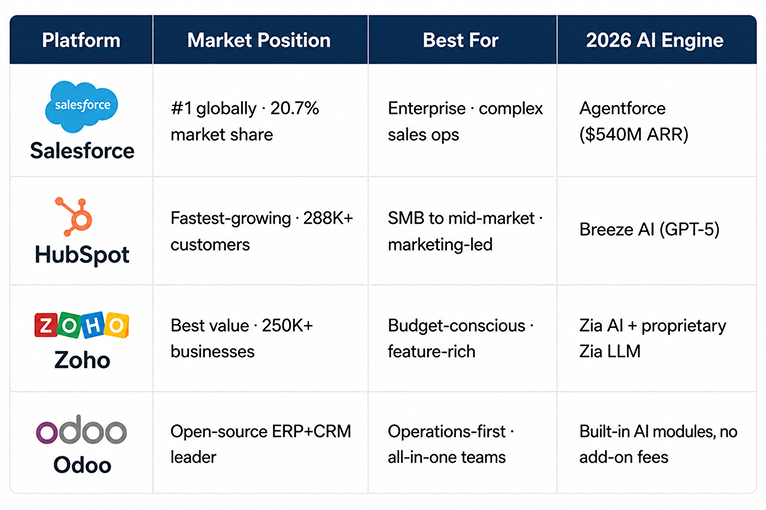
Before diving into trends, let's take a moment to appreciate the unique roles each platform plays in the market. They're not just competitors; they serve diverse business needs and have distinct strategies when it comes to pricing, AI, and operations. Understanding this sets a solid foundation for our exploration!
Each platform is responding to the same underlying shifts but with very different strategies, price points, and trade-offs. Keep this in mind as we walk through the trends below.
Trend 1: Agentic AI CRM Systems That Think and Act on Their Own
This is the defining trend of 2026, and it changes everything.
For years, AI in CRM was a copilot: it suggested an email subject line, flagged a stalled deal, and recommended the best time to call. Useful, but still dependent on a human to act.
In 2026, that has fundamentally changed. 'Agentic AI' refers to AI systems that don't just recommend, but execute. Autonomously. Without waiting to be told.
A CRM agent in 2026 can qualify an inbound lead, write a personalised outreach email, schedule a follow-up, update the pipeline stage, and flag the deal to a manager if it goes quiet, all without a single human keystroke. This isn't a feature preview. It's in production, at scale, right now.
Gartner projects that 40% of enterprise applications will embed task-specific AI agents by the end of 2026. The businesses that understand this shift and act on it will have a structural sales and service advantage that compounds over time.
How each platform delivers agentic AI:
Salesforce Agentforce:
Salesforce's flagship AI product is built on the Atlas Reasoning Engine, a system that understands user intent, determines what data and actions are needed, and executes autonomously within enterprise security guardrails. Agentforce SDR Agents autonomously screen inbound leads, run outreach sequences, and update CRM records without human intervention.
As of 2026, Agentforce has reached $540M ARR, serves 18,500 customers, and processes over 3 billion monthly agent workflows. It is the most powerful agentic CRM framework available and the most expensive to implement.
HubSpot Breeze Copilot
HubSpot has developed a three-layer system for its Breeze platform:
Breeze Copilot (conversational AI embedded in a CRM), Breeze Agents (autonomous end-to-end workflows), and Breeze Intelligence (data enrichment and buyer intent signals). Breeze Studio agents will run on GPT-5 starting in January 2026, resulting in significant improvements in reasoning and agent performance. Early adopters report that average deal close times have decreased by 48%. There is no need for a separate AI add-on subscription with HubSpot's Breeze AI. An agentic CRM solution is most cost-effective for teams under 50 people.
Zoho:
Zoho's Zia has evolved from an intelligent assistant into a full agentic AI system. Zia Agent Studio gives teams 700+ pre-built actions across the Zoho ecosystem, with a fully prompt-based, no-code builder, meaning non-technical users can configure agents themselves.
What makes Zoho's approach unique is its Agent2Agent (A2A) protocol, which enables Zia agents to interact and collaborate with agents on other platforms. This open-standard approach positions Zoho at the forefront of inter-agent communication. Zoho has also launched the Zia LLM, a proprietary large language model trained entirely in-house, giving it data sovereignty that third-party model-dependent platforms cannot match.
Odoo:
Open-Source AI Modules Odoo takes a different path entirely: open-source AI capabilities with no per-agent licensing fees. For businesses that want agentic capabilities without committing to enterprise-level pricing, Odoo's AI-enabled CRM workflows covering lead scoring, automated follow-ups, and pipeline management can be extended and customised freely by any development team. The ceiling is only the team's own capability, not a vendor's pricing tier.
AI is not coming to CRM; it's already here. If your current platform still requires humans to trigger every meaningful action, it's already behind.
Trend 2: Hyper-Personalization: Every Interaction, Tailor-Made
Businesses will lose revenue in 2026 due to generic messaging. The gap between businesses using AI-driven personalization and those using manual segmentation is widening every quarter, with 62% of companies reporting that AI has significantly improved customer service through personalization.
Hyper-personalisation in CRM means every touchpoint, every email, every follow-up, every piece of content is dynamically generated based on that specific customer's behaviour, history, preferences, and current intent signals. Not a segment of 10,000 people. One person.
Consider a real-world example: an eLearning platform uses AI to analyse each prospect's engagement patterns. which course topics they've clicked, how long they've spent on the pricing page, which blog posts they've read, and automatically generates a personalised email sequence that speaks directly to their stated challenges. No human writes those emails. The conversion rate lifts measurably.
How each platform delivers hyper-personalisation:
Salesforce: Einstein Personalisation
Einstein analyses actual CRM data, deal history, call recordings, email engagement, and campaign responses, and uses it to personalise outbound emails, call preparation summaries, and marketing campaign sequences. Every output is grounded in your specific customer data, not generic templates.
HubSpot: Breeze Intelligence
Breeze Intelligence enriches contact records from a database of 200M+ business profiles, automatically populating missing fields and identifying buying intent signals. Nurture sequences dynamically adapt based on behavioural triggers in real time. If a prospect visits your pricing page twice in a week, Breeze can automatically shift them to a higher-urgency sequence without manual intervention.
Zoho: Zia Personalisation Features
Zia analyses the optimal time to contact each lead (not just the best time in general but the best time for that person), performs email sentiment analysis to gauge how a prospect is feeling about a conversation, and generates churn risk scores per customer record. The level of individual-level intelligence available at Zoho's price point is genuinely exceptional.
Odoo: Native Personalization, No Third-Party Required
Odoo's built-in email marketing module and website builder are directly integrated with CRM data, meaning personalised campaigns, dynamic content blocks, and behavioural triggers are configured inside the same system, with no data transfer to a third-party marketing tool. For businesses that want personalisation without adding another SaaS subscription, this is a significant advantage.
AI enhances repeat sales and customer retention by 15% through hyper-personalisation and automation. If your CRM is still sending the same email to everyone in a segment, you're leaving that 15% on the table.
Trend 3: Predictive Analytics: From Rearview Mirror to GPS
Traditional CRM was retrospective; it told you what happened. A closed deal. A lost opportunity. A churned customer. By the time the data was in the system, the window to act had often already closed.
In 2026, predictive CRM analytics tells you what is about to happen and prescribes what to do about it.
Think of it this way: your old CRM was a rearview mirror. Your 2026 CRM is a GPS. It knows there's a traffic jam three miles ahead and has already rerouted you before you hit it.
IDC projects that nearly half of all new CRM-related investment in 2026 will go into data architecture, AI infrastructure, and analytics, not additional user licences. Businesses have realised that more seats without better intelligence are just more noise.
How each platform delivers predictive analytics:
Salesforce: Einstein Predictive Lead Scoring
Einstein analyses historical conversion patterns, engagement signals, and firmographic data to produce lead scores that accurately predict conversion probability. Sales leaders report forecast accuracy within 2–3% of actual results when Einstein forecasting is properly configured. Territory management, deal health scoring, and pipeline risk flags are all AI-generated.
HubSpot: Breeze Forecasting
Breeze AI predicts future revenue based on activity patterns and confidence intervals based on historical sales data.
The integration with marketing data gives HubSpot a full-funnel view of what's likely to close, connecting top-of-funnel intent signals to bottom-of-funnel outcomes.
Zoho: Zia Anomaly Detection
Zia goes beyond standard lead scoring with anomaly detection and real-time alerts when metrics deviate from expected patterns. If a sales rep's close rate drops suddenly, or if deal velocity in a territory slows unexpectedly, Zia flags it before it shows up in a monthly review. For subscription businesses, Zia generates churn scores and can identify the specific product or service a customer is at risk of cancelling, allowing proactive intervention.
Odoo: Unified Operational Forecasting
Odoo's forecasting dashboards unify data across sales, inventory, and finance in a single view without a separate analytics subscription. For businesses where sales and operations are tightly linked (manufacturing, distribution, and retail), having inventory levels, purchase orders, and sales pipeline in one forecasting view is a capability that pure-CRM platforms cannot match without expensive integrations.
AI enhances sales forecast accuracy by over 40%. If your team is still building forecasts in spreadsheets, you're making decisions based on a map that's already outdated.
Trend 4: CRM + ERP Integration
Here's a scenario that happens every day in businesses running legacy CRM setups: a sales rep closes a deal. The finance team doesn't know about it yet. The inventory team hasn't been notified. The project manager is waiting for a handoff email. Three departments. Three separate systems. One customer is falling through the cracks.
In 2026, the trend is toward a single live customer record that every team – sales, finance, operations, HR, marketing, support draws from simultaneously.
More than 80% of enterprises are deploying GenAI in production by 2026, but AI is only as good as the data it touches. Disconnected systems don't just create silos; they actively corrupt the AI's output. Clean, connected data is the foundation that every other trend in this list depends on.
How each platform handles integration:
Salesforce — Data Cloud + AppExchange
Salesforce's Data Cloud unifies customer data from across an organisation's entire tech stack and makes it available for AI use cases with governance built in. The AppExchange ecosystem offers 7,000+ integrations, making Salesforce theoretically connectable to almost any other system. The caveat: each integration typically adds licensing cost, and the total cost of a fully integrated Salesforce stack for mid-market businesses can escalate significantly.
HubSpot — 2,000+ Certified Integrations
HubSpot connects strongly across marketing, sales, and service tools. Its integration marketplace is comprehensive for GTM (go-to-market) workflows. However, HubSpot does not natively cover accounting, HR, manufacturing, or inventory — for businesses needing those connections, third-party integrations, or a separate ERP system are still required.
Zoho One — The Most Connected SMB Suite
Zoho One bundles 55+ native applications under a single flat-rate subscription CRM, Zoho Books (accounting), Zoho People (HR), Zoho Desk (support), Zoho Campaigns (marketing), Zoho Analytics, and more. For SMBs that want the operational breadth of an enterprise stack without enterprise pricing, Zoho One is arguably the strongest proposition in 2026.
Odoo — The True All-in-One
Odoo is the only platform in this comparison that was designed from the ground up as a unified ERP+CRM system. 70+ official apps, CRM, Sales, Accounting, Inventory, Manufacturing, eCommerce, HR, project management, and website are all built on the same database, the same interface, and included in one per-user price. There are no add-on fees for connecting sales to inventory. There is no data pipeline to maintain between your CRM and your accounting system. For operations-first businesses, this architectural difference is not a minor feature. It is a fundamental competitive advantage.
The question is no longer whether your CRM integrates with your ERP. It's whether you need them to be separate systems at all.
Trend 5: Privacy-First Data Governance: Clean Data = Smarter AI
AI is only as intelligent as the data it learns from. And in 2026, "feeding the AI" without a rigorous governance strategy is not just a compliance risk, it's a business risk.
The market has reached a moment of reckoning. Buying more CRM features will not fix broken data ownership. Organisations that have invested heavily in AI capabilities are discovering that messy, ungoverned data produces AI recommendations that are at best unreliable and at worst actively harmful to customer relationships.
Three principles define privacy-first CRM governance in 2026:
Consent-first data collection — every customer record must have a clear, documented basis for data processing
Zero-trust architecture — no user, device, or application is trusted by default; every access request is verified
Data sovereignty — knowing exactly where customer data is processed, stored, and who has access to it
How each platform approaches governance:
Salesforce — Einstein Trust Layer
Salesforce has built enterprise-grade data guardrails into Agentforce via the Einstein Trust Layer. When AI agents process customer data during automated tasks, the Trust Layer ensures data does not leave the Salesforce boundary, a critical assurance for regulated industries.
HubSpot — Third-Party LLM Risk
HubSpot's Breeze AI runs on GPT-5, a third-party model. This means customer data processed through Breeze AI may pass through OpenAI's infrastructure. For businesses in healthcare, financial services, legal, or other regulated sectors, this is a material data sovereignty concern that requires careful evaluation before full adoption.
Zoho — Zia LLM: Proprietary and Private
Zoho has taken the most aggressive privacy posture of any major CRM vendor. The Zia LLM is a proprietary large language model trained entirely in-house on Nvidia infrastructure. Customer data processed by Zia never leaves Zoho's servers. For organisations where data residency is non-negotiable, this is a decisive advantage, and it arrives at a fraction of the cost of comparable Salesforce security configurations.
Odoo — On-Premise Sovereignty
Odoo's open-source community edition can be deployed entirely on a business's own servers or in a private cloud of the company's choosing. For the most stringent data sovereignty requirements (government, defence, healthcare, financial services), Odoo's on-premise deployment gives complete infrastructure control that no SaaS-only platform can replicate.
In 2026, compliance is not a constraint on growth. It's a competitive advantage. The businesses with the cleanest, most governed data will build the most effective AI systems.
Trend 6: Composable & No-Code CRM
Updating a CRM workflow used to require filing a developer ticket and waiting two weeks. The subscription model is broken in 2026, and businesses are voting with their subscriptions.
The rise of composable CRM reflects a market-wide rejection of monolithic all-in-one suites that lock businesses into rigid architectures. Instead, forward-thinking businesses are building modular stacks: a core CRM connected to best-fit tools via APIs, where individual components can be swapped without rebuilding the entire system.
Today, no-code builders have advanced so that sales operation managers, marketing coordinators, and customer success leads can modify workflows, create automations, and update pipeline logic independently, without needing engineering assistance.
For scaling SMBs and fast-moving startups, this is transformative. Speed of iteration is often the difference between winning and losing a market.
How each platform enables no-code and composability:
Salesforce: Agentforce Builder
Salesforce's Agentforce Builder allows teams to build, test, and tune AI agents. Each agent compiles to a portable JSON file for versioning, sharing, and collaboration across teams. It's important to note that full configuration requires solid Salesforce admin knowledge. We are not developing a tool for "business users" as we do today.
HubSpot — Breeze Marketplace
Find and deploy HubSpot-built agents and custom assistants with HubSpot's Breeze Marketplace and combine them to create complex, multi-step workflows with zero code. Where HubSpot really wins out is in time-to-value: implementations that take months on Salesforce take days or weeks on HubSpot. This is a massive operational unlock for non-technical revenue teams.
Zoho — Canvas + Zia Agent Studio
Zoho's Canvas is a no-code CRM interface builder that allows teams to design completely custom CRM views without any developer involvement, A capability that HubSpot's clean but fixed interface cannot match. On the automation side, Zia Agent Studio provides 700+ pre-built actions across the Zoho ecosystem with a fully prompt-based no-code builder. For the price, this is the most powerful no-code toolset available in the CRM market today.
Odoo — Odoo Studio
Odoo's Odoo Studio is a drag-and-drop application builder and workflow editor that requires no developer. Because Odoo is open source, the customisation ceiling is effectively unlimited; any developer can fork the codebase and build precisely what the business needs. For teams that want the flexibility of a custom-built CRM with the speed of a SaaS product, Odoo's combination of Studio and open-source access is unique in the market.
The CRM your team won't use is the worst investment you'll ever make. No-code tools that put workflow control back in the hands of the people doing the work produce dramatically higher adoption rates and better data quality as a result.
Trend 7 CRM Evolves Into a Company-Wide CXM Platform
This is the most strategically significant shift of 2026 and the one most businesses are least prepared for.
Historically, CRM was a sales tool. It lived in the sales department, was maintained by sales ops, and pipeline metrics measured its success. Every other department had its own system, its own data, and its own view of the customer.
In 2026, that structure is actively harmful to business performance.
CRM is becoming CXM (Customer Experience Management), a platform that serves every department that touches the customer lifecycle: sales, marketing, customer success, product, and finance. The business implication is profound: when every team draws from the same live customer record, decisions become faster, more consistent, and more customer-centric. Handoffs between departments become seamless. The customer never has to repeat themselves.
CRM use already boosts customer retention by 27%, but that number climbs significantly when the platform is deployed company-wide rather than just in sales.
How each platform enables the CXM model:
Salesforce — The Most Complete, Most Expensive Suite
Salesforce's full CXM stack, Sales Cloud, Service Cloud, Marketing Cloud, Commerce Cloud, and Tableau CRM combination, is the most feature-complete offering in the market. Every department gets dedicated tooling, all connected through Salesforce's shared data model. The trade-off is cost: a full-stack Salesforce deployment for a mid-sized company is a significant investment, requiring specialised admin and implementation expertise to configure and maintain.
HubSpot — The Best Cross-Team User Experience
HubSpot's Marketing Hub + Sales Hub + Service Hub + CMS Hub, unified on the Smart CRM platform, delivers the cleanest cross-department experience in the market. Teams that actually use HubSpot user adoption rates consistently beat Salesforce in mid-market evaluations, which means the data is cleaner, the automations fire correctly, and the customer view stays accurate. The limitation is the enterprise pricing ceiling: as team sizes grow, HubSpot's bundled Hub pricing escalates quickly.
Zoho One — Strongest Value for Full-Organisation Rollout
Zoho One's flat-rate subscription model covering CRM + Desk + Campaigns + Analytics + People + Books under one licence makes company-wide CXM deployment genuinely affordable for businesses that would be priced out of a comparable Salesforce configuration. The trade-off is polish: individual Zoho apps are functional and capable, but the design coherence across the suite is less refined than HubSpot or Salesforce.
Odoo — True Single Source of Truth
Odoo's architecture makes it the most literal interpretation of the CXM vision: every department – sales, HR, finance, e-commerce, inventory, support, and manufacturing – on a single open-source platform, sharing one database. There is no data syncing. There is no API maintenance. There is no "source of truth" debate between systems. For businesses that have struggled with data fragmentation across multiple SaaS tools, Odoo's unified approach is not just efficient.
The question in 2026 is not "Does sales have a CRM?" It's "Does the entire organisation have a unified view of the customer?" The answer to that question determines how fast you can grow.
Trend 8: Voice AI and Omnichannel CRM: Meeting Customers Where They Are
The channels through which customers engage are multiplying email, phone, WhatsApp, SMS, Instagram DMs, Telegram, live chat, and social comments. In 2026, customers expect the experience to feel consistent, regardless of which channel they choose.
Voice AI has made significant progress. Using Salesforce's Agent Force Voice, brands can now deliver human-quality phone interactions that reflect their unique tone and personality. Customer inquiries start by phone 80% of the time, so voice-enabled CRM isn't a new concept anymore. The business world cannot ignore this channel.
How each platform handles omnichannel:
Salesforce
Agentforce voice + SMS + digital channels unified through Service Cloud. Most sophisticated omnichannel orchestration on the market.
HubSpot:
Customer Agents now deploy across SMS, Instagram, Telegram, LINE, WhatsApp, and Slack via the Custom Channels API with no code changes required. Breeze automates the generation of contextually appropriate responses per channel.
Zoho:
Full multi-channel engagement via Zoho Desk and Zoho SalesIQ covering web, email, phone, and social channels. Particularly strong for customer support workflows.
Odoo:
Native Live Chat and Email integrations connected directly to CRM. Omnichannel sophistication is more limited compared to the other three, but it is actively expanding via community modules.
A customer who starts a conversation on WhatsApp and has to re-explain their situation when they call your support line is a customer building a case to switch to your competitor. Omnichannel CRM closes that gap.
Which CRM will work best for your business in 2026?
Using the Quick Decision Guide
The "best" CRM in 2026 will not exist universally. It entirely depends on your business size, budget, operational complexity, and growth trajectory.
Choose Salesforce if...
You are a mid-to-large enterprise with a dedicated sales ops or CRM admin team
You have complex sales processes, multi-stakeholder deal cycles, territory management, and CPQ
AI depth and customisation matter more than speed of implementation
You have the budget to support the ecosystem: typically $165–$330+/user/month for full AI capabilities
Long-term scalability and enterprise security are non-negotiable
Choose HubSpot if...
You are a 10–500 person company with a marketing-led growth motion
Your teams want a unified marketing, sales, and service platform they'll actually adopt and use.
You want quick time to value. HubSpot implementation takes days to weeks, not months.
You want to include Breeze AI in your plan with no separate AI licence cost.
Pricing range: $20–$150/user/month, depending on hub and tier
Choose Zoho if...
You want maximum features per pound/dollar at every pricing tier.
You are price-sensitive but unwilling to sacrifice AI capability. Zia AI is free for everyone. Up to 30M free tokens/month for standard.
Data privacy matters. Zoho's proprietary Zia LLM means your customer data never leaves Zoho's infrastructure
You want to grow into a connected business suite (Zoho One) without changing platforms
Pricing range: $14–$52/user/month
Choose Odoo if...
You need a CRM and business operations in one system that should cover inventory, accounting, HR, manufacturing, and ecommerce
You need open-source flexibility so that you can customize, self-host, and extend it without the need for vendor approval.
You're comfortable with an implementation period, but no per-module fees are acceptable.
Data sovereignty is critical in on-premise deployment, which gives complete infrastructure control.
Pricing: single per-user price covers all 70+ apps, no artificial feature limits.
Final Thoughts
The Window to Adapt Is Now
The CRM trends in 2026 are not predictions. They are already happening. Businesses are already running agentic AI that closes deals while their teams sleep. Sales leaders are already reading AI-generated forecasts that are accurate within 2–3% of actual results. Marketing teams are already sending personalised campaigns to individual buyers based on real-time behavioural data.
The gap between businesses that have adopted these capabilities and those still running 2020-era CRM workflows is widening every quarter.
The CRM you choose in 2026 won't just manage your contacts. It will define how fast your business can think, act, and grow.
This is the time to find out whether you're still running on a legacy setup or whether you've outgrown your current platform. Compare Salesforce, Hubspot, Zoho, and Odoo based on your business needs, team size, scope of operation, AI needs, and budget. The top CRM software to grow your business in 2026 won't be the most expensive. It's the one your team will use in an environment that brings together everything that matters.
